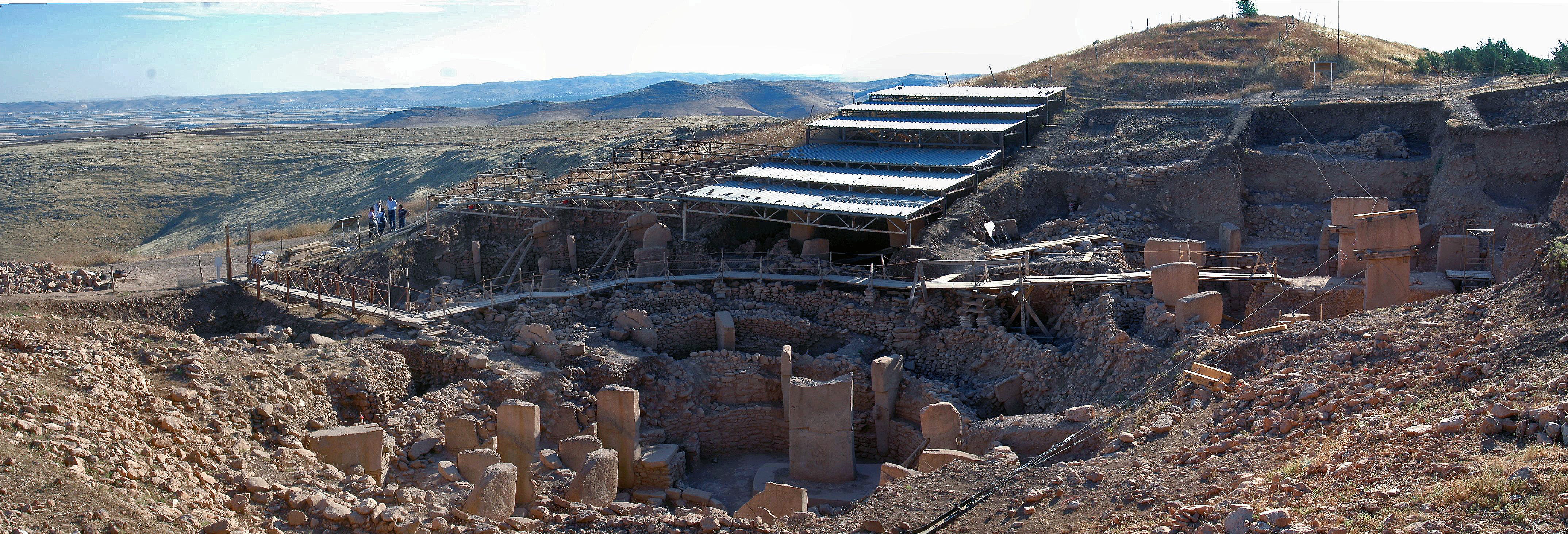
Göbekli Tepe from the east, 25 May 2010. Rolf Cosar, via Wikimedia Commons, CC BY-SA 4.0. Documentary photograph; web display may resize the original.
Göbekli Tepe draws the eye upward, toward carved animals and enormous T-shaped pillars. Yet some of the most useful evidence lies among the smaller pieces: flakes, cores, tools, and the debris of ordinary work.
That contrast matters. The site is often introduced as a monument that overturned everything archaeologists knew about hunter-gatherers. A closer reading of the excavation research reveals something more valuable: a place whose interpretation has changed as its evidence has grown.
The question
How could communities organize substantial construction during the early Neolithic, and what was the relationship between these buildings, everyday settlement, and changing food economies?
“Before agriculture” is useful only if we say what it means. Collecting wild plants, cultivating them, producing domesticated varieties, and relying primarily on farming are different conditions. A monument cannot, by itself, tell us which combination supported its builders.
EVIDENCE · A site in transition
Göbekli Tepe is in southeastern Türkiye and belongs to the tenth and ninth millennia BCE. The research project situates it within the Pre-Pottery Neolithic, a period central to understanding changing settlement and subsistence. Its architecture and sculpture are extraordinary, but the site is also an archaeological deposit that has been excavated and re-examined over decades. Göbekli Tepe Research Project.
Lee Clare’s summary of the 2015–2019 investigations provides an important checkpoint for readers relying on older descriptions. Research is cumulative: a compelling account from an earlier excavation phase is not automatically the best account of the site today. Clare, 2020.
EVIDENCE · The small finds change the picture
In a 2023 account, lithics specialist Jonas Breuers reported that chipped-stone studies support domestic activities at Göbekli Tepe. He also stressed a complication: some excavated assemblages contain material mixed through processes that formed and altered the deposits. The less disturbed groups are therefore especially important.
The project’s interpretation is a settlement with a strong ritual component, rather than a specialized place without domestic activity. This does not remove the significance of its monumental buildings. It changes the setting in which we try to explain them. Breuers, “Chipped Stones,” 5 July 2023, on the excavation-project website.
INTERPRETATION · Cooperation is visible; its rules are harder to recover
Construction required people to coordinate actions. But the inference from “people worked together” to “we know who controlled them” is much larger than it first appears.
A project might be supported through obligations among households, seasonal gatherings, influential individuals, shared practices, or combinations that changed through time. These are possibilities to test. The presence of pillars alone cannot choose between them.
Research on gathering and feasting has explored how collective events could create social ties and mobilize labor. That is an explanatory proposal, not a recovered description of a particular ceremony. It is useful because it connects practical questions about food and work with questions about community, but it still needs to be assessed against the archaeological contexts. Dietrich and colleagues: gathering, feasting, and food production.
What the site does not settle
The evidence does not give us the builders’ names, a translated statement of their beliefs, or a complete account of their political arrangements. Animal images are real observations; a proposed meaning for an image is an interpretation. Repeating that distinction makes the site more interesting, because it reveals where an explanation is doing work beyond the surviving facts.
Nor should all activities be forced into one moment. Buildings were used, altered, abandoned, and incorporated into a changing place. A reconstruction that compresses the entire site into one scene can conceal the sequence that archaeologists are trying to recover.
OPEN QUESTION · What would help?
Three kinds of evidence would sharpen this investigation: better-resolved sequences for particular buildings; securely associated food and activity remains; and comparisons with nearby contemporary communities. Each could help distinguish changes within the site from differences between places.
The goal is not to make the mystery disappear. It is to ask a more precise question than “How was this possible?” Human communities clearly made it possible. The research challenge is to understand the relationships, skills, and circumstances through which they did so.
Further reading: The excavation project’s publication register includes later work and should be consulted alongside the dated studies discussed here.