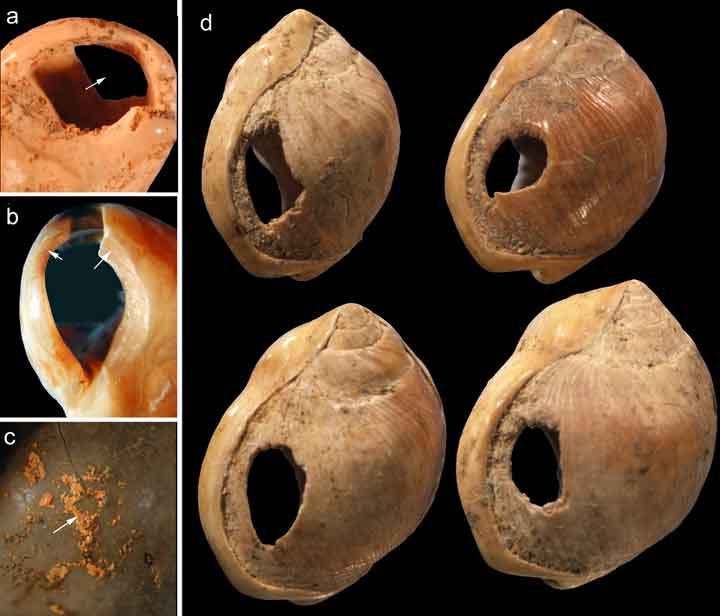
Blombos Cave shell beads. Photographs by Chris Henshilwood and Francesco d’Errico, via Wikimedia Commons, CC BY 2.5. Web display may resize the original.

A line of red pigment on stone. A small shell carried, pierced, and worn. An animal painted where light barely reaches. Such objects bring us close to prehistoric choices, yet the meanings behind those choices can remain out of reach.
When did people begin to think symbolically? Archaeology can investigate that question, but it cannot identify a single birthday for the human imagination. It works with surviving traces, and each kind of trace answers a different question.
EVIDENCE · A deliberately drawn pattern
At Blombos Cave in South Africa, researchers described a cross-hatched ochre drawing on a silcrete flake from deposits approximately 73,000 years old. Microscopic and chemical analyses supported deliberate application of pigment with an ochre crayon. Henshilwood and colleagues, 2018.
The finding establishes graphic behavior in this context. It does not supply a translation. The design’s meaning, if it had a shared conventional meaning, is a separate question from whether someone intentionally made it.
EVIDENCE · Ornaments before the familiar cave galleries
A 2021 study described 33 shell beads from Bizmoune Cave in Morocco, many from deposits dated to at least 142,000 years ago. Their significance lies partly in the question of personal ornament: objects selected and used in ways that could make social information visible. Sehasseh and colleagues, 2021.
At Blombos, a detailed study examined marine shells from Middle Stone Age contexts, including their modification and use. This is the kind of work needed to distinguish an ornament from an attractive shell that happened to enter a deposit. d’Errico and colleagues, 2005.
INTERPRETATION: Ornaments may have communicated belonging, identity, or relationships. Those are plausible classes of explanation. They do not tell us the exact identity signaled by a particular bead, or allow a reconstruction of the wearer’s vocabulary.
EVIDENCE · Painted scenes and minimum ages
Research published in 2024 reported a painted scene at Leang Karampuang in Sulawesi with a minimum age of 51,200 years. The authors interpreted the relationship between its figures as narrative art. Oktaviana and colleagues, 2024.
Two distinctions matter here. The dating result provides a minimum age under the study’s method and assumptions. The identification of a narrative concerns the relationship and intended meaning of the figures. A reader should be able to evaluate those arguments separately.
An image can be old without its subject being fully understood. It can also preserve a recognizable subject while leaving the reasons for painting it unknown. These are limits of the evidence, not failures of imagination.
INTERPRETATION · Shared forms and social connections
Symbols gain meaning through people. This makes repeated forms and conventions especially interesting, but similarities must still be investigated rather than treated as automatic proof of one culture.
A study of ostrich-eggshell beads compared material from eastern and southern Africa across the last 50,000 years. The authors used patterns in bead characteristics, age, and location to argue for changing social connections. The result demonstrates a method for asking about networks through small objects; it does not reconstruct every encounter between their makers. Miller and Wang, 2022.
Why a single “creative revolution” is too simple
The examples here differ in date, medium, place, and the kind of inference they support. Grouping them under symbolic behavior can be useful, provided that the label does not erase those differences.
A mark, an ornament, a painted scene, and spoken language are not interchangeable evidence. Neither are symbolic practice and a complete religious system. The temptation is to make one surviving object carry an entire account of the mind that produced it. A better question is smaller: what does this object establish, and what does it leave open?
OPEN QUESTION · The meanings we cannot yet recover
How were conventions taught? Which objects were personal, and which carried shared expectations? Were images retold through stories, or did their meanings change between generations? Which important practices used bodies, voices, wood, or fibers that have disappeared?
Future work may refine dates, recover additional contexts, or identify repeated patterns. It may also leave some meanings permanently uncertain. That does not diminish the people behind the traces. It reminds us that the small portion of their world we can excavate was never the whole of their lives.
Reading principle: Deliberate manufacture, archaeological age, social use, and symbolic meaning are related questions. They require distinct evidence, and confidence in one should not silently become confidence in all the others.